
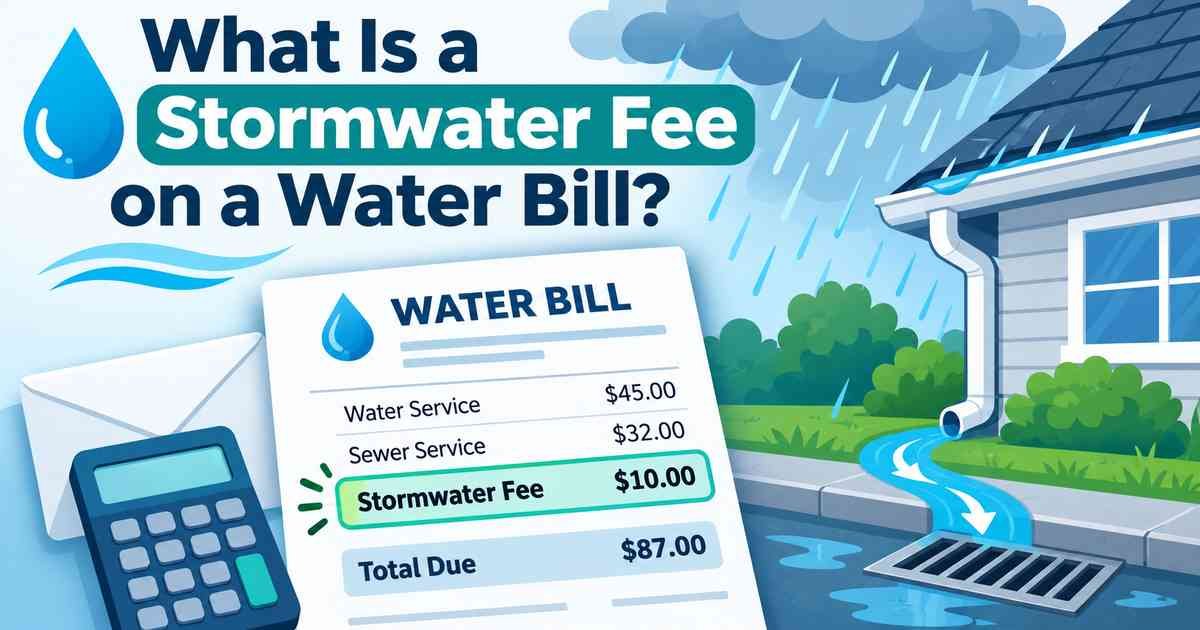
A stormwater fee on a water bill is a charge that helps pay for managing rainwater runoff. The money generally supports drainage facilities, maintenance, flood-control infrastructure and water-quality programs. It is not a charge for the number of gallons you drink, shower with or flush down a toilet.
Stormwater fees can appear under names such as storm drainage, surface water, drainage utility, rainwater management, or stormwater service. Whether your city charges one, and how much you owe, depends on the approved local rules. The fee may be collected on a water bill even when the water and stormwater systems are funded separately. Our water bill reading guide explains how this charge differs from metered water and wastewater.
What does a stormwater fee pay for?
When rain falls on grass or permeable ground, part of the water can soak into soil. On roofs, streets, patios and parking lots, more water tends to flow across the surface. Drainage networks collect and carry runoff, and municipal systems may manage pollutants before water reaches rivers and streams.
Public agencies need funding to inspect drains, maintain pipes and channels, respond to flooding, remove debris, manage detention facilities and satisfy applicable water-quality requirements. A stormwater fee is one way a city or utility recovers those ongoing costs. The exact list of funded activities varies locally.
The U.S. Environmental Protection Agency explains that impervious surfaces affect runoff volume and peak flow. This is why stormwater billing often depends on property characteristics instead of kitchen and bathroom consumption. See the EPA explanation of urban runoff.
How is a stormwater fee calculated?
There is no universal American stormwater rate. A city may assign a flat fee to qualifying residential properties, use equivalent residential units, or calculate charges using a measurement of impervious area. Other approaches depend on parcel category, runoff contribution or local utility policy.
Method 1: a flat monthly residential fee
Under a flat fee, similar residential properties may be billed the same amount regardless of the water used inside. The charge could still depend on property type or account classification. A small household and a larger household might therefore see the same stormwater amount.
Philadelphia is a useful real-world example. Its Water Department explains that eligible residential properties generally pay a standard flat monthly charge based on citywide average property and impervious area. This charge can apply even to residential properties without active drinking-water service. Read the official Philadelphia residential stormwater explanation.
Method 2: an equivalent residential unit (ERU)
An ERU represents a standardized amount of impervious area that is used to estimate a property’s impact on runoff. A utility assigns one or more ERUs based on its policy. The term does not mean one resident, one water meter or one actual unit of water consumption.
For 2026, Boston Water and Sewer Commission lists $9.06 per ERU per month. Its rate documentation explains that a residential unit represents 2,164 square feet of impervious surface and that one- through six-unit residential properties are charged one ERU, subject to the qualifying parcel rules. Other property types can be billed according to measured impervious area and rounded ERUs. See Boston’s official rates.
Method 3: calculated impervious area
Some commercial, multifamily or other properties are charged for the amount of roof and pavement shown in a property assessment. In a simplified example, an authority may charge $7 per 1,000 square feet of billable impervious area. If an eligible parcel has 3,000 square feet, the hypothetical fee would be $21 for the stated billing period.
That arithmetic is only an illustration. Real schedules may use ERU rounding, minimum fees, property classes, credits, annual instead of monthly billing or different units. Verify the rate and measured area from the responsible stormwater authority.
Stormwater versus water versus sewer
| Line item | What it generally funds | Common billing basis |
|---|---|---|
| Water | Treatment and delivery of drinking water | Metered usage plus service fee |
| Sewer or wastewater | Collection and treatment of used water | Metered water, winter average or separate rule |
| Stormwater | Rainfall runoff and drainage management | Parcel classification, impervious area or flat charge |
The three services are related but not identical. The amount of rain falling on a property is not necessarily measured on its household water meter. That is why a stormwater fee can stay the same while the water-usage charge falls after a conservation effort.
For a deeper look at wastewater and its different billing rules, read why your sewer bill can exceed your water bill. For regular usage and fixed fees, see our water and sewer bill calculator.
2026 examples from Boston and Philadelphia
Boston: The 2026 published stormwater rate is $9.06 per ERU per month. Its official documents explain how impervious area and residential classification affect the ERU calculation. The property must meet the applicable criteria; not every building is automatically assessed the same way.
Philadelphia: From September 1, 2026, its published typical monthly residential example includes a $23.05 stormwater charge. The whole illustrative water, sewer, service and stormwater bill is $96.16 for a 5/8-inch meter and 430 cubic feet of water use. Your individual bill can differ because this is a standard scenario, not a quote. See the official rate announcement.
These two values should not be treated as evidence that one city is always cheaper for stormwater. The cities define eligibility, fees and service scope differently. Read the 2026 city water and sewer rate guide for additional local context and links to all five city calculators.
Why is the charge still there when I use no water?
Stormwater runoff can occur regardless of whether someone is living in the property or running water indoors. A vacant home may still have a roof, driveway and paved areas that contribute runoff. In some local systems, the fee is attached to the parcel, not measured household consumption.
For example, Philadelphia explicitly states that its residential flat stormwater charge can apply to residential properties without water service. Other utilities may have different exclusions, account rules or vacancy policies. Do not assume that a zero-gallon reading automatically qualifies you for a refund.
If the property is vacant, uninhabitable, demolished, incorrectly classified, or not connected to the relevant program, contact the stormwater billing office and ask about exemptions or corrections. Requirements vary. Keep any supporting property and service documents.
Can you reduce or appeal a stormwater fee?
First determine whether the amount is a flat rate or a property-based charge. If the fee is property-based, an appeal may concern impervious-area measurements, parcel classification, duplicate billing, or eligibility for a specific credit. If the charge is fixed by residential classification, simply using less water may have no effect.
Some cities offer incentives for approved rain gardens, permeable paving, detention facilities or other stormwater controls. But approval rules differ. In fact, Philadelphia says that residential stormwater credits are not currently available, even though its Rain Check program supports some runoff-management improvements. A rain barrel does not automatically lower that city’s fee.
Request the current stormwater ordinance, rate schedule, parcel calculation and appeal process from the billing authority. For the broader dispute process, see how to challenge a water bill. Ask for a written explanation, including the deadline and supporting documents, before committing money to drainage improvements for the purpose of obtaining a credit.
How to verify a stormwater charge on your statement
- Locate the exact line item. Check whether it says stormwater, surface water, drainage or another local term. Do not confuse it with sewer service.
- Identify the billing agency. The collecting water utility may only be processing the charge for another city office.
- Check the billing period. Determine whether the published fee is monthly, bimonthly, quarterly or annual.
- Confirm the classification. Find out whether your property is single-family, multifamily, commercial, vacant land or another category.
- Request the basis of the amount. Ask about ERUs, impervious-area measurements, flat rates, minimums, rounding and any credits.
- Check for errors. A wrong parcel size or duplicated assessment should be documented and reviewed through the official process.
If you are trying to check your full utility amount, the U.S. water bill calculator accepts a manually entered other-charge value. Put the known stormwater charge there when using the appropriate inputs for the same billing period. It does not estimate stormwater automatically from your property area.
Frequently asked questions
Is a stormwater fee a tax?
It depends on the law and billing program in your jurisdiction. Some systems collect stormwater as a utility service fee; others use different legal mechanisms. The line-item name does not answer the legal classification.
Do renters have to pay stormwater fees?
The fee may be billed to the account holder or property owner. Whether a landlord can allocate it to tenants depends on the rental agreement and local rules. Ask for the original utility charge and any applicable allocation method.
Does less rain mean a smaller stormwater fee?
Not automatically. Many charges are based on property characteristics rather than measured rainfall in a given month. A local rate change or credit may affect the amount.
Does the fee mean my home is connected to a storm sewer?
Not necessarily. A stormwater program can manage broader drainage and runoff impacts. Ask the utility about geographic coverage and exemptions.
Why is the charge on my water bill instead of a property-tax bill?
Utilities often use an existing billing system to collect several local service charges. That collection method does not determine how the fee is calculated.
Can a rain barrel eliminate the charge?
Only if a local program provides an applicable credit or exemption. Some cities encourage rain barrels without reducing residential stormwater fees.
What should I do if the fee appears twice?
Contact the billing provider with a copy of both charges, parcel or service information, dates and account details. Request confirmation of the correct assessment and adjustment procedure.
Conclusion
A stormwater fee is mainly about managing rainwater runoff, not measuring drinking-water consumption. Start by identifying your local charge method, checking the period and confirming any property classification or credits. If a separate meter-reading estimate also appears on your statement, read our estimated water bill guide. For a billing dispute, use the official utility’s tariff and appeal procedure rather than a national average.
Disclaimer: This article is general educational information. Rates, tax treatment, eligibility, fees and appeals differ by jurisdiction and may change. The applicable local utility or government authority is the source for your account.